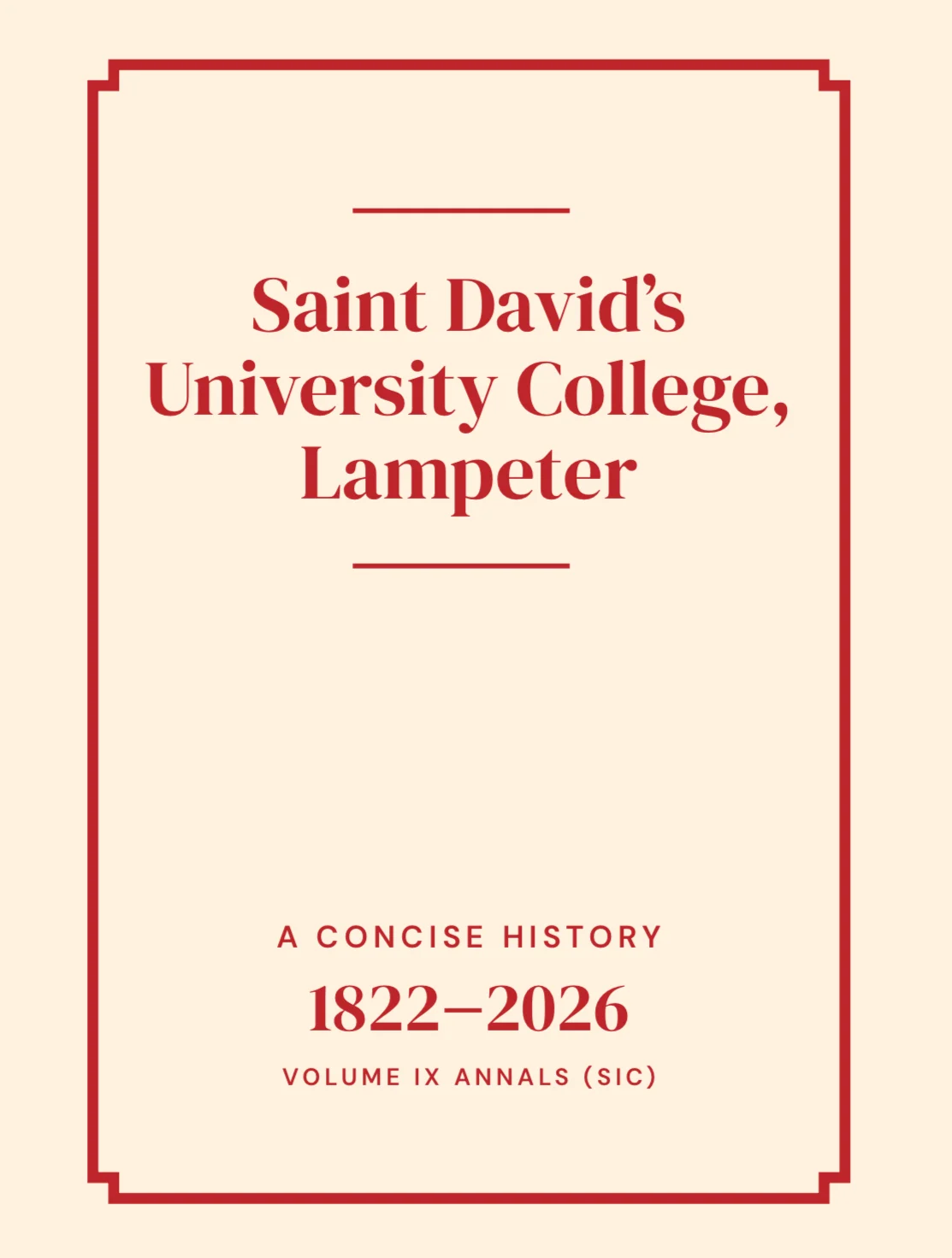
Saint David's University College, Lampeter
A Concise History 1822–2026
Two centuries of Wales's smallest, oldest, most stubbornly resilient university college — collected at last into 612 pages nobody can quite agree are necessary.
£24.00
In stock · Ships from a small print-house in the foothills of Eyjafjallajökull, Iceland. Please wait 6-8 weeks for delivery.

Volume IX · Annals (sic.)
format
Hardcover, regrettable heft
pages
612 (incl. 90-pg index)
publisher
ISBN
About the book
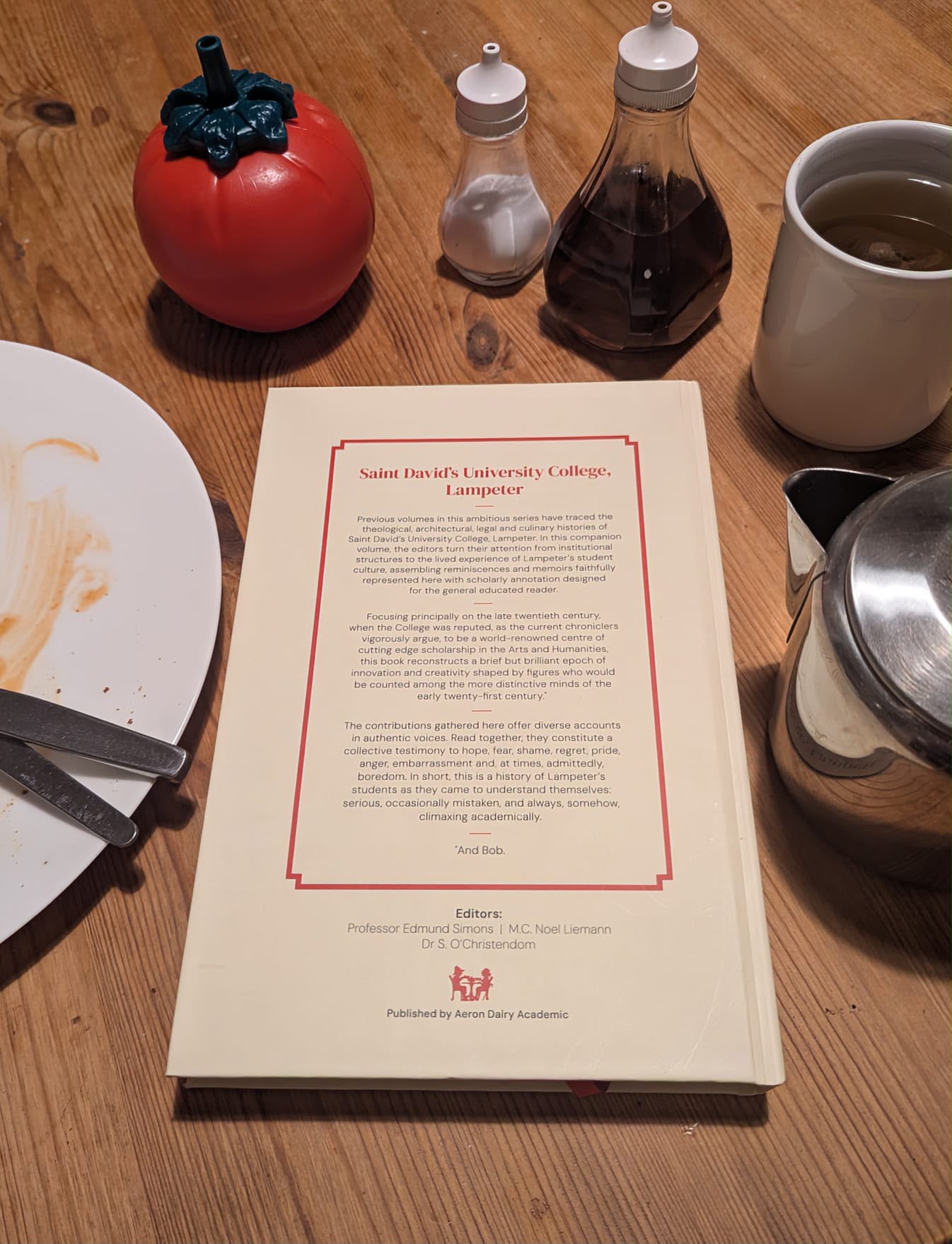
A concise — and we use the word generously — chronicle of the smallest university in Britain, and the 204 years of people who refused to let the rain put it out of business.
In 1822, Bishop Burgess decided that what west Wales urgently needed was a university. Almost no-one agreed. Two centuries, four name-changes, one fire, several mergers, and a great deal of polite endurance later, Saint David's College is still there — still in Lampeter, still mildly damp, and still producing graduates who can quote Aquinas before breakfast.
Volume IX is the latest, longest and least necessary instalment in the Concise History series. It collects the annals previously sealed in the basement under the bound copies of Wisden, and renders them, where the librarians permit, into prose a layperson can love. Where they do not permit, the original Latin appears in the footnotes alongside the original misprints.
Includes 38 archival plates, a fold-out map of the campus c.1885 (now sadly out of date by exactly one tea hut), a chapter-length apology for the 1971 merger debate, and an index so thorough it has been described by one reader as "a small career in itself."
The dust-jacket band reading "Borderline Unreadable" is not a marketing flourish — it is a direct quote from our copy-editor, who has been with the press since 1987 and has, as of this volume, formally given up.
What readers are saying
Eleri Hughes
"Found four factual errors. Couldn't be happier."
The footnotes alone are worth the cover price. I disagree with the dating of the 1887 fire, the spelling of two principals, and the entire chapter on the boathouse — which is, in my profession, the highest compliment I can pay a history book. Buy two; lend one out and never get it back.
Pippa Thwaite
"My father-in-law gave me this. Our relationship has not recovered."
Two stars because it does prop open the conservatory door very well, and because the dust-jacket is the same beige as my carpet so I can pretend it isn't there. I have not opened it. I never will. Send help.
Dr Dafydd Morgan
"Made me cry into a small, regional ale."
I haven't walked the quad in thirty years. By chapter forty I was back there — the bell, the rain, the smell of the chapel pews, the feeling that my dissertation supervisor was about to materialise from behind a hedge. A quietly tremendous achievement, even if the chapter on the buttery is — and I will die on this hill — wrong about the eggs.
Siân Roberts
"Refuses, magnificently, to be interesting."
And is somehow much better for it. The 1971 merger debate is rendered with such forensic detachment that I emerged caring deeply about a meeting I was not at and did not previously know occurred. Knock a star off for the Latin, which the editor has cheerfully left untranslated as a sort of class filter.
Revd Robert Beddoe
"I am mentioned on page 318. They have spelt my name 'Bedude'."
I have written to the publisher. I have received no reply. I have written again. One star — which I will gladly upgrade to four upon receipt of an erratum slip and a written apology. The chapter on the chapel was, I will admit, surprisingly fair.
James Llewellyn
"Cured a twenty-year sleep disorder by page 60."
I cannot, hand on heart, tell you what the book is about. I have started it nine times. I have woken up in the chair, on the train, and once in a Tesco car park. But I sleep, reader — I sleep. Five stars. The fold-out map is also nice.